

ARM, DSP & FPGA Boards, Tools & Algorithmen, Systeme für Baugruppentest

DSL (C-OFDM) Modem-Datenpumpe für industrielle Anwendungen
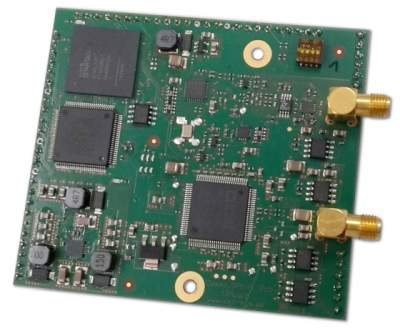 In Ergänzung zu unserem minimalistischen OFDM-Modem 'CosmoLite' haben wir eine Modem-Datenpumpe entwickelt, die wesentlich flexibler und leistungsfähiger ist. Das Modem steht als fertig konfiguriertes Modul mit zahlreichen Optionen zur Verfügung und kann in Industriesystemen, die eine robuste und sehr schnelle Kommunikation benötigen, eingebettet werden.
Das Modem zeichnet sich durch folgende Eigenschaften aus:
Signalverarbeitung: Kombination von DSP (SHARC) und FPGA (Spartan-6)
Übertragungsmedien: Koaxialkabel, Twisted Pair oder andere 2/4-Draht-Verbindung
Einsatzgebiete: Mittel- und Hochspannungsnetze, Datenfunk
Übertragungstechnik: Symmetrisch, Assymmetrisch, Full Duplex oder Half Duplex
Duplex-Arten: Frequency Division Duplex (FDD) oder Time Division Duplex (TDD)
Topologien: Point-to-Point (PtP) oder multi-drop PtmP (multiple endpoints)
Kanalbandbreiten: 9 kHz to 580kHz, in Software wählbar
Mittenfrequenzen: einstellbar von 15 kHz bis 100 MHz
Kanaleffizienz: bis zu 10.7bit/s/Hz
Detaillierte technische Daten entnehmen Sie bitte dem Datenblatt, das auf Anfrage erhältlich ist.
System-on-Module mit Intel Cyclone 10 LP
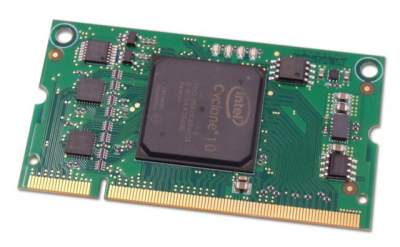 XynergyCY10 ist ein System-on-Module im SO-DIMM-Format (67,6mm x 37,5mm), auf einem Intel Cyclone 10 LP FPGA basiert. Mit zwei Ethernet-Ports, zahlreichen LVDS- und single-ended I/O-Leitungen eignet es sich für vielfältige Signalverarbeitungsaufgaben und als EtherCAT-Slave.
In der Standardversion ist das Modul mit einem 10CL055YF484I7G (55 KLE) ausgestattet. Mit optionalen Logikdichten von 25 KLE bis 120 KLE kann das Modul auf die Anforderungen der Anwendungen skaliert werden. Das Modul passt in 200-polige Sockel, die dem DDR2-Standard entsprechen.
Mit 128MBit seriellem Flash und 2MBit EEPROM ist das Modul für zwei Konfigurationsdateien, umfangreiche Anwendungsdaten und Parameter ausgestattet. Lediglich eine 3,3 Volt-Stromversorgung ist zum Betrieb des Moduls erforderlich.
Ein Breakout-Board für den schnellen Einstieg ist verfügbar. Unterstützt vom NIOS II Prozessor eignet sich XynergyCY10 sind Automatisierung, mehrkanalige Signalverarbeitung, Bildverarbeitung, Embedded Computing, Smart Grid etc.
Hier finden Sie das Datenblatt. Bei Interesse nutzen Sie bitte unser Kontaktformular für weitere Informationen.
i.MX6 System-on-Module im SMARC-Format
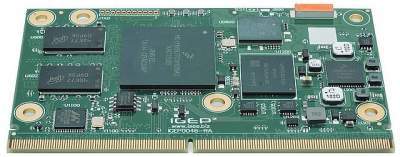 ICEP SMARC iMX6 ist eine Familie von Prozessormodulen im SMARC-Format. Das Modul ist mit allen Varianten des i.MX6 von NXP und mit unterschiedlichen Speicherausstattungen erhältlich. Vom i.MX6 Solo mit einem Cortex-A9 Core, über i.MX6 DualLite, i.MX6 Dual, jeweils mit zwei Cores, bis zum besonders leistungsfähigen Vierkerner i.MX6 Quad stehen alle Leistungsklassen zur Verfügung. Für Anfragen benutzen Sie bitte unser Kontakformular.
Detaillierte technische Information finden Sie auf der Website des Herstellers.
Entwicklung von Hardware und Software für Embedded Systeme
Unser Thema: Dienstleistungen, Hardware und Algorithmen für Industrie- und Kommunikationsanwendungen mit digitalen Signalprozessoren (DSP) und FPGA. Wenn Sie Unterstützung bei Ihrem Projekt suchen, wir sind die Experten, die Ihnen das Leben leichter machen.
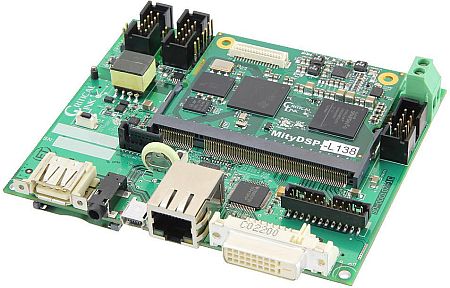 Wir entwickeln für unsere Kunden spezielle ARM-, DSP- und FPGA-Boards für eine Vielzahl von Anwendungen, z.B. Laser-Controller für Beschriftungsanwendungen, Controller für autonome Hafenfahrzeuge, digitale Türsprecheinrichtungen, Powerline-Modems für Hochspannungsleitungen und vieles mehr. Dabei liefern wir alles bis zu produktionsfertigen Leiterplatten-Datensätzen, die Inbetriebnahme von Baugruppen, Entwicklung von VHDL-Code und Firmware bzw. embedded Software oder auch nur Teilprojekte - ganz wie Sie es brauchen. Außerdem stellen wir Prototypen von durch uns entwickelte Baugruppen her und umgehen damit den zeitaufwändigen Einsatz eines externen Bestückungsdienstleisters. Bei der Serienfertigung arbeiten wir aber mit renommierten EMS-Unternehmen zusammen. Das Unternehmen hat seit 1995 seinen Sitz in Düsseldorf, mitten im Herzen von Europa. Alle Mitarbeiter kommen aus der Region und leben für die Arbeit, die sie täglich abliefern. Wir sind stolz darauf, dass viele unserer Kunden uns seit vielen Jahren die Treue halten.
Algorithmen
Unsere Sprach-Algorithmen entsprechen den einschlägigen Standards (ITU-T bzw. ETSI). Sie werden nicht nur in Telekommunikationseinrichtungen, sondern auch in industriellen embedded Anwendungen eingesetzt. Unsere Algorithmen für Echo-Unterdrückung und Noise-Cancellation eignen sich hervorragend für Freisprechanwendungen, z.B. in Fahrzeugen. Unser OFDM-Modem-Algorithmus ist ein Produkt Jahrzehnte langer Entwicklung. Soweit uns bekannt gibt es kein vergleichbar robustes und effizientes OFDM-Modem. Es wird in zahlreichen Anwendungen eingesetzt, z.B. zur Datenkommunikation auf Überlandleitungen, in Systemüberwachungen im Power Grid, bei der digitalen Audioübertragung in Industrieanlagen und in der Videoüberwachung.
Hardwareprodukte mit ARM, DSP und FPGA
Außer den oben genannten DSP-Algorithmen haben wir eine Reihe von embedded Produkten, ARM- und DSP-Module und -Boards, teils mit FPGA, für High-Perfomance-Computing und Kommunikation entwickelt, u.a.:
- Embedded OFDM Modem für robuste drahtgebundene Kommunikation
- SO-DIMM-Module mit STM32 Cortex-M4, Spartan-6 FPGA und DDR3-RAM
- Modul für Sprachverarbeitung mit Blackfin und 2-Kanal Audio-Interface
- Modul für Audiosignalverarbeitung mit SHARC mit 2-Kanal-Audio-Interface und S/PDIF-Schnittstelle
Qualitätsmanagement
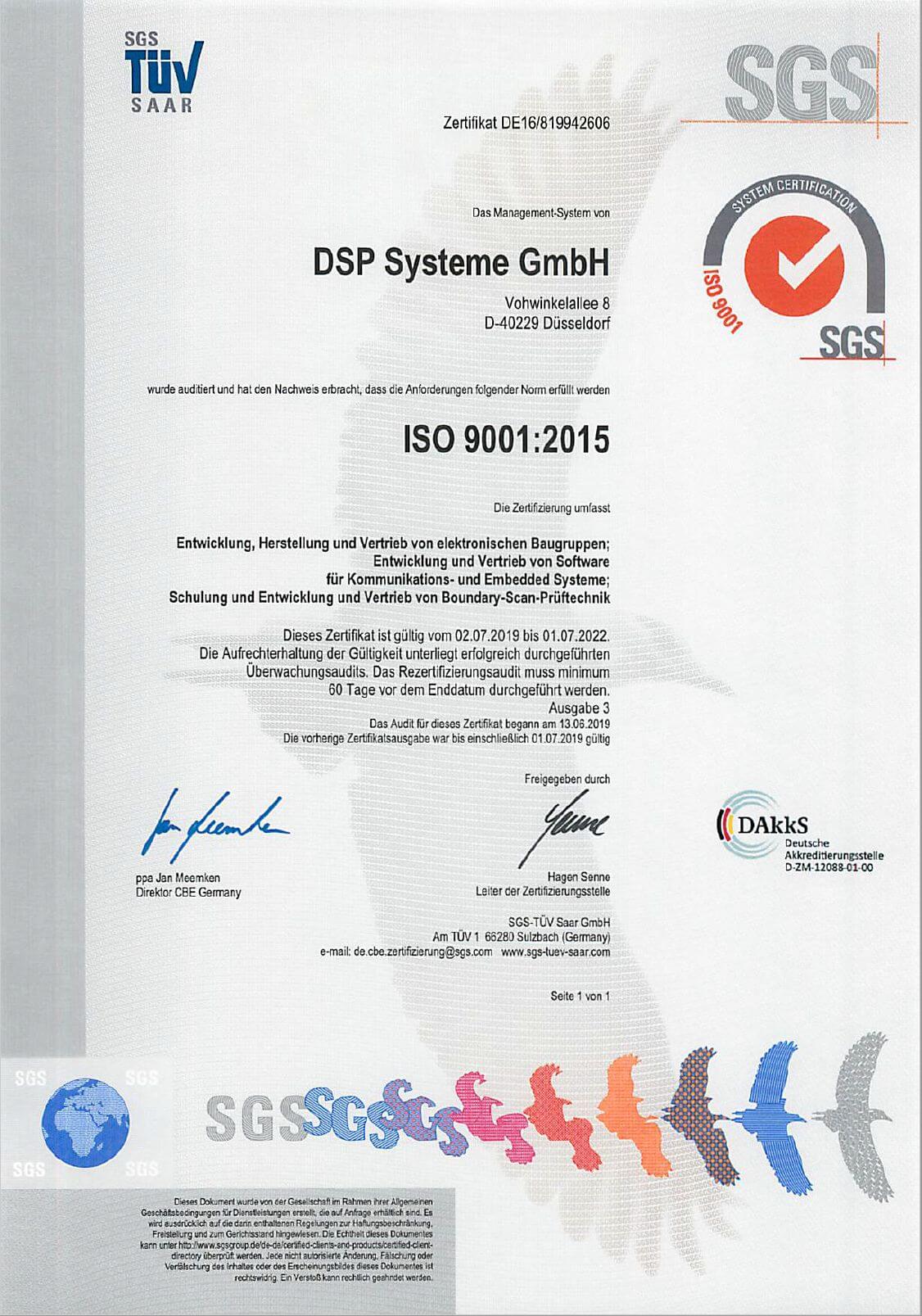
Unser Qualitätsmanagement ist nach ISO9001-2015 zertifiziert. Wir garantieren Ihnen damit höchste technische und administrative Standards.
System-on-Modules, JTAG-Emulatoren und Produkte für Baugruppentests mit Boundary-Scan
In Zentraleuropa vertreten wir mehrere Anbieter von hochperformanten Produkten und Entwicklungswerkzeugen für die digitale Signalverarbeitung:
Informationen über ARM-, CPU- und FPGA-Module sowie industrielle Kamerasysteme (MitySoM, MityDSP, MityFPGA) finden Sie bei Critical Link.
Informationen über Blackhawk Emulatoren für Texas Instruments Code Composer Studio und Zubehör finden Sie unter www.blackhawk-dsp.com.
Informationen über Corelis JTAG Boundary Scan Produkte, die bei der Prüfung von Baugruppen während der Entwicklung und in der Produktion eingesetzt werden, erhalten Sie bei Corelis.
Fragen zu all diesen Produkten beantworten wir Ihnen gerne.
DSP Systeme GmbH (vormals: A.R. BAYER DSP Systeme GmbH)
Vohwinkelallee 8
40229 Düsseldorf Germany
Phone: +49 - 211 - 271 46 30
Fax: +49 - 211 - 210 81 76
Kontakt per Email